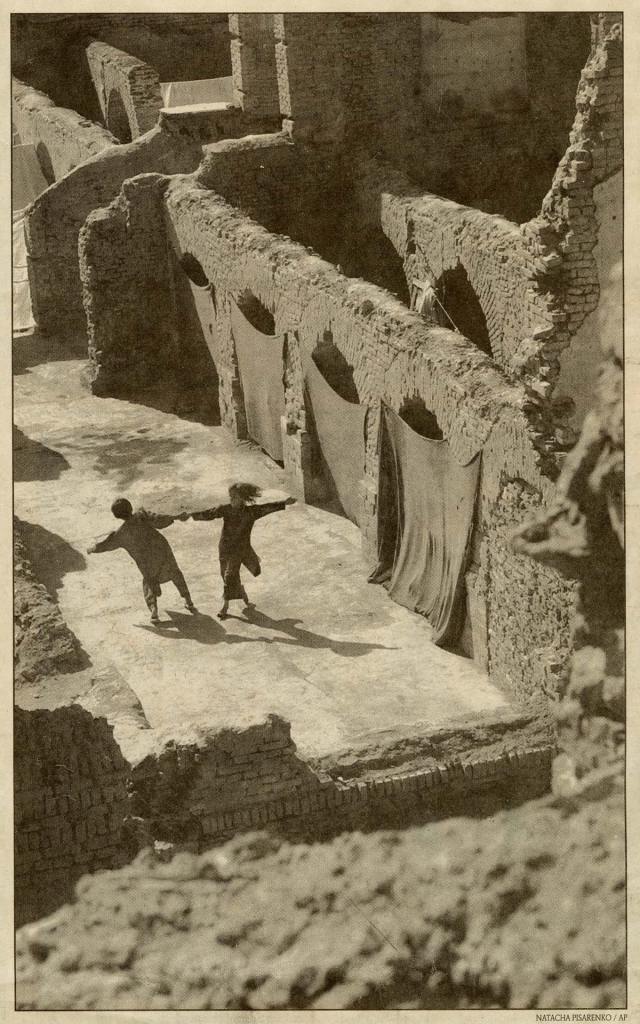
Two Afghan refugees, who returned from Pakistan, take a moment to be children, playing outside the building in Kabul, the capital, where they live. The building was destroyed during the civil war in 1992. – The Post Intelligencer, Tuesday, September 2, 2003
In March, after I saw the aerial photograph of mass graves at the Iranian girls’ school burial site, I could not stop thinking about another photograph I had seen in 2003. At that time we were a year into the war in Afghanistan, in what was optimistically dubbed “Operation Enduring Freedom.” After a brief two months scuffle in which the Taliban was “defeated” the war went on to last for another 20 years. I still read a paper newspaper in 2003. This was long before AI, and when I turned to page 4 of The Post Intelligencer I did not have to ask if what it showed me was “fake.” I cut the photograph out and kept it on my bulletin board for weeks, during which its power only grew. These two children hand in hand, the smallness of their bodies against the ruins, their ragged shadows whirling across sunlit rubble, and behind them the easy-to-miss but telling placement of drapes across each gaping bombed out doorway— the photograph closed the distance between the far away and nearby like nothing else I had seen.
I contacted the newspaper and purchased a print, which I tucked away in my flat files and promptly forgot about while I kept the newspaper clipping on my wall. The real and visceral experience was the newsprint itself. The smell of it. The ink. The warmth of the paper and the image, soft and grainy. The official photograph, shiny and cold and bluish black, was divorced from emotion— and said nothing of sunlight. Here on the screen, with its strong black and white contrast, it may feel compelling; but as an object, badly printed quickly in a newsroom on glossy paper, it said nothing of the human immediacy of war.
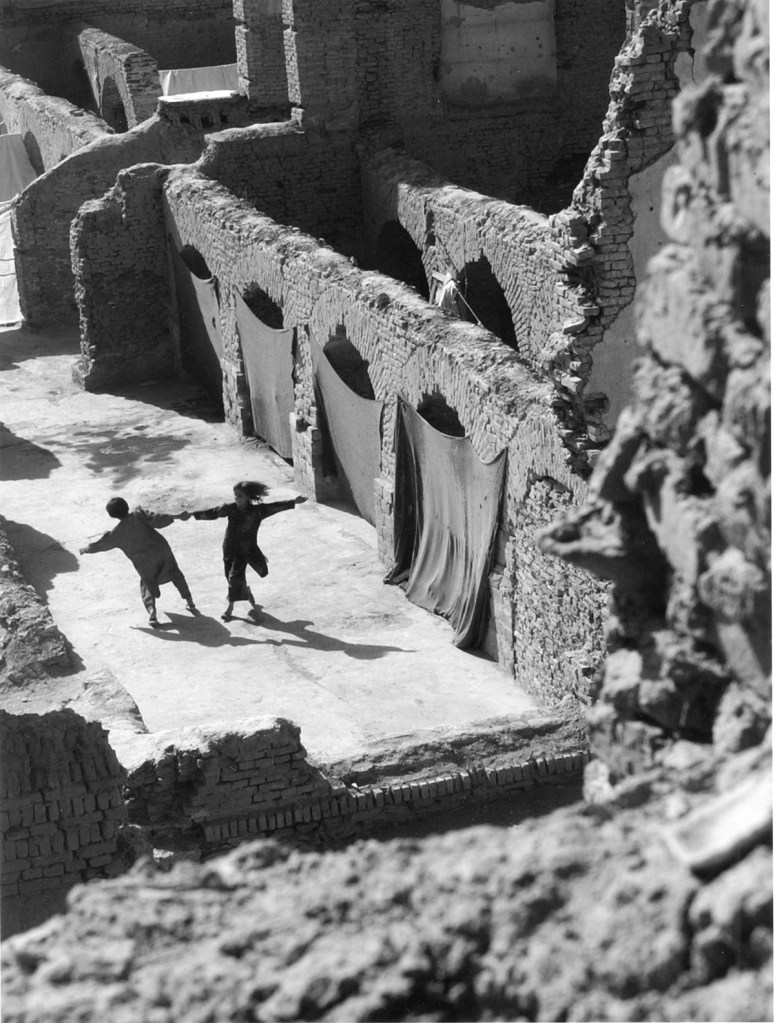
The photographic print
This March however, I had forgotten the reason I buried the photo, and spent hours guiltily sorting through flat files trying to find it. When I laid it next to the clipping, it made me think about the evolution of our media universe and how it has crushed both our attention span and our ability to be shocked into empathy. Most of us consume news on a mobile device or a screen, and in one day we can see hundreds, if not thousands of images, reduced to pixels and lost in the blur of scrolling. Our own military is confusing our experience further by mixing footage of video games with actual war footage, turning reality into propaganda. The most commonly asked question in social media today under any news photograph, is “is it real?”
Two famous photographs, one in 1968 and one in 1972, transformed public opinion about the Vietnam war and changed its course. Both photographs depicted the reality of the war in ways that Americans could no longer shrug away or deny. I don’t know if images today still possess that power. Natacha Pisarenko’s photograph of two Afghani children playing certainly did not stop the war in Afghanistan. Perversely, the image might have suggested an enduring resilience that could be taken for granted, rather than the fragile joy of childhood, pleading for protection.
A photograph is an act of witness, and its effect expands in relation to how the viewer is able to see it. In this world of media overload and propaganda, it is easy to feel personally assaulted, to long for ones own psychic protection, and to turn away. I hope in spite of this we continue to value and keep safe our human capacity for empathy. Far away is right here: behind the word “casualty” is people like these two children dancing in the sun.
Used with permission of the photographer, Natacha Pisarenko
 The Iskra Journal
Leave a comment