. . . and the political becomes personal.
It has been over a year since I launched this blog, and after several months of absence, I have been reflecting on the changes since then. In an early post I told the story of sitting at a Starbucks on Highway 99, where I met a woman wearing a map of Moldavia printed on her shirt. She was reading a book, an act of rare distinction in the age of phones. The tilt of a head over a phone creates an inviolate cone of absorption that warns away interruption. Although our phones are subject to surveillance — and the entire world lives in the device, its intrusions ever ready to fracture our thoughts — the phone still somehow manages to signify a private room. In contrast, a book, and the act of turning the pages in public, invites curiosity. What are you reading? is historically an acceptable question for one reader to ask another, a social gambit offered under the assumption that a book signifies membership in a friendly tribe. Looking back, I feel like this woman’s answer portended everything that has followed in the year since. You must read it, she said: On Tyranny: Twenty Lessons from the Twentieth Century.
The escalation of authoritarianism and the collapse of democratic norms since that moment has been breathtaking. My April post about “The New Chautauqua” seems quaint. If you can remember that far back, some of us were upset then at something called DOGE, the dismantling of government agencies from Health, Education, Agriculture and FEMA to the IRS and Social Security, and the executive branch’s withholding of funds already appropriated by Congress. We know now where that money has been reallocated. At $29 billion, the annual budget for ICE exceeds the entire defense budgets of Israel and Italy. Instead of protecting Americans from weather catastrophes, flooding and fires, disease or the next pandemic, our government is obsessively focused on protecting us from immigrants, and from those who would object to the massive deportation program, which aims to remove one million people per year. It is the treatment of the objectors that finally broke through to the American public and began to waken them to the authoritarian project.
When a white mother of three and a white male VA nurse are shown being publicly executed in the streets for exercising free speech, and when the executions play endlessly on our phones, the private media room morphs, disturbingly, into public space. Unlike the police shootings of George Floyd and other Black people, the violence to Renee Good and Alex Pretti cannot be dismissed by white viewers as something happening to “others.”
Instead, without the pretext of race, the Minnesota victims have been blamed for being variously: female, gay, disrespectful, “mouthy” and in Alex Pretti’s case, legally carrying a gun, which was removed from his pocket before he was shot 10 times. The comments section, led within minutes by our government’s highest officials, nonetheless fabricated false narratives rife with character assassination and outright lies. This has not worked: 80 percent of American voters saw the videos of Alex Pretti’s execution, and they know the truth of what their eyes told them. Suddenly the reflexive shrug at violence done to “others” cannot hold for the shocked audience of the white, the female, the parents, the nurses, the gun owners.
How many times have I heard someone say I don’t follow politics, it’s got nothing to do with me—?
I always want to ask these people what they think “politics” is. My definition is simple: politics is people I don’t know with more power than I have making decisions that control my life or the lives of people I care about. This happens 24 hours a day, and I find it hard to think of a reason I would ignore it. When “people I care about” broadens to caring about the environment, animals, birds, lands far away and people I don’t know it is as much due to self-interest as empathy. I have always been able to imagine what is far away arriving in my backyard.
When it comes to civil liberties and freedom of speech, I have personal experience. As a child in the 1960’s, I sang “We Shall Overcome” at Seattle’s Freedom Schools, and marched with others in solidarity with the March on Washington. My parents sheltered friends hiding from Seattle’s version of the McCarthy inquisition in our basement. My mother went to prison for civil disobedience during protests against nuclear weapons. “Politics” was indistinguishable from daily life.
We are being encouraged by a new wave of opinion leaders on the right to question empathy (rebranded as “toxic” by the religious right), and to keep the radius of who we extend compassion to tightly drawn. Stephen Miller has even questioned the legitimacy of the poem on the Statue of Liberty which has, since 1903, welcomed the immigrants who pass through New York Harbor:
“Give me your tired, your poor,
Your huddled masses yearning to breathe free,
The wretched refuse of your teeming shore.
Send these, the homeless, tempest-tost to me,
I lift my lamp beside the golden door!”
That America is a nation of immigrants, a “melting pot,” has been understood for over a century as part of what makes us uniquely successful as a nation. This does not mean Americans want criminals let in, or an unvetted flood of immigrants that overwhelms communities’ ability to absorb them. But a record high 79% of Americans think immigration is good for the country (2025/Gallup), The Cato Institute, a pillar of conservative thought, has just released a study showing that Immigrants reduced deficits by $14.5 trillion since 1994.
We can’t know what percentage of those turning against the administration’s deportation policies are doing so out of empathy. But for those who are not moved by the pain of people they don’t know, I believe pure self-interest has been triggered by the visceral images on the streets of Minnesota at a level most “a-political” Americans have not experienced in my lifetime. Over 170 American citizens have been held in ICE detention. The administration has stated it wants to denaturalize up to 200 United States citizens per month. What seemed far away now seems like it could be next door.
The Epstein Files
This brings us to the other raging news story that has pricked the public’s bubble of immunity to “politics”: The Epstein Files. Conservatively speaking, one in four women and one in 7 men have been sexually abused as children. The slow drip of revelations about Jeffrey Epstein and his sordid web of degradation has thrown millions of survivors into a cycle of re-trumatization, as they absorb the details of abuse that mirrors their own. It has become clear that Epstein’s network of influence extended to the highest levels of government, academia, finance and culture.
Although the Trump administration withheld the files for a year, claiming it was taking that time to protect and redact survivor information, the release has come with shocking failures of privacy. While perpetrators’ names have for the most part been rigorously redacted, victim names and faces and bodies have not. From The Wall Street Journal:
“Some of the missing redactions are unusual. For example, in one 2008 email where U.S. attorneys are discussing the list of victims they need to contact, 10 names are redacted and one that is in the middle of the list is left exposed.
Another document from 2016 shows a long list of women that are being identified as Epstein victims. Only one name on the list is redacted and the rest of the first and last names are public.
In one 2014 email exchange between a victim and the male modeling scout who recruited her into Epstein’s network, the scout’s email address is redacted while the victim’s isn’t properly redacted.”
43 out of 47 reviewed victim names were left unredacted. The errors left victim locations, emails and social security numbers exposed, and has led to threats and disruption of the lives of nearly 100 people.
This administration’s cruelty is boundless. Its behavior seems to mirror, with bureaucratic and lethal stealth, the way ICE treats people on the streets and in their custody, with violence and threats. It’s all intended to flaunt power, and to suppress resistance. To intimidate. We are told we must stop resisting the imprisonment and racial profiling of our neighbors, and ignore the sexual exploitation of our mothers and children and sisters by the elites. It is hard enough to hold the violence of hourly headlines, but on top of that we are continually gaslit by the highest levels of our government, which tells us what we see and hear is not true.
It’s a lot. A sense of darkness has permeated the world, and anyone who is following the news may find it increasingly difficult to sleep. When danger that was distant is suddenly close, when images trigger traumatic memories, when you know a neighbor or family member may be deported by masked men with guns, or tear gas filters through the windows, it is easy to allow fear and a sense of unsafety to permeate everything one sees.
How do we hold the extremes of this time?
It is a daily challenge to keep perspective, distinguish between legitimate worry and irrational panic, and weigh the personal cost of empathy. In following the news I often pay the price of insomnia and overwhelming sorrow. Yet I also find hope in the new journalism platforms, particularly Substack, on which dedicated citizens insist on finding and sharing the truth.
We will not learn what is really going on in our world in a mostly co-opted and fearful mainstream media. The real news, sandwiched between partisan hyperbole and AI propaganda is increasingly on YouTube, Threads, Medium and Substack. Although I read The Atlantic daily, I first go to Marry Geddry https://substack.com/@marygeddry, and Heather Cox Richardson https://heathercoxrichardson.substack.com, usually via Facebook. I then read or listen to a dozen independent news sources on Youtube and Substack before turning to traditional journalism, and my local Seattle Times, The New York Times, the remaining shreds of The Washington Post, and for balance, The Wall Street Journal.
From Heather, who feels now like a first-name friend, I gather historical context. From Mary Geddry I gather the strength of metaphor and a beauty of language that helps me do my own work, the daily practice of writing and art.
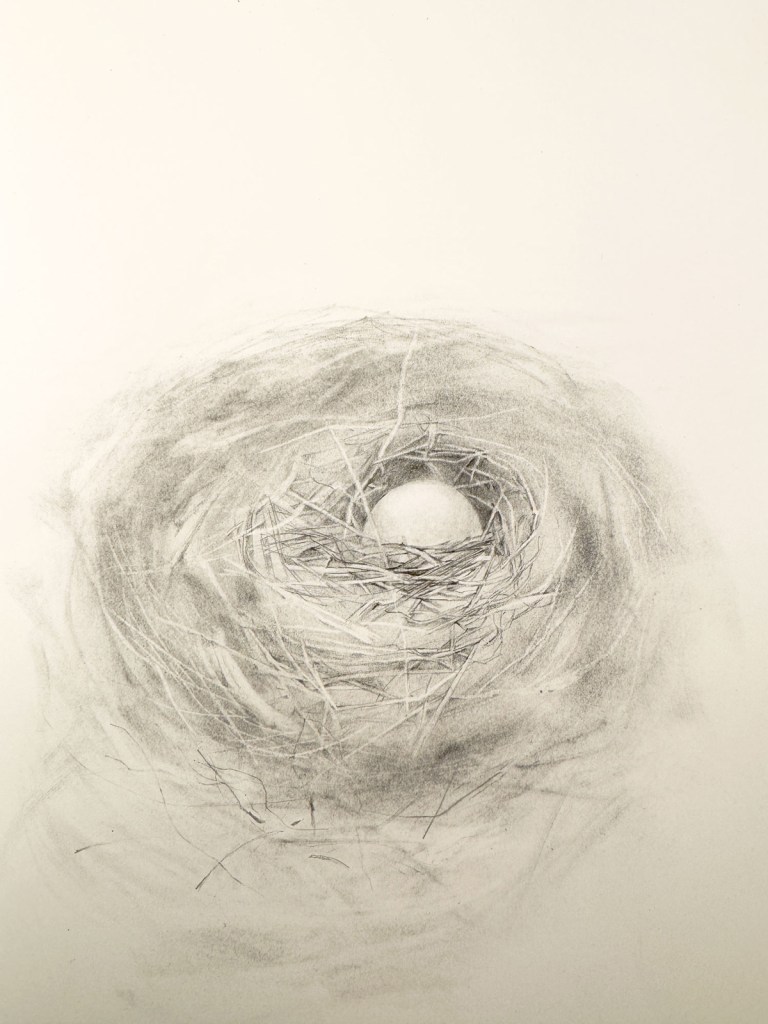
The theme that sustains me right now, against all odds, is fragility itself. In one hand these times ask us to hold the worst of human impulse, and in the other, what is most precious, fragile and affirming of life. The slow hours of studying an eggshell at my kitchen table return me to the sacred. Here, with a simple pencil and a sheet of paper, I can become absorbed in contemplation, and try my best to honor the gentleness and beauty I feel called to protect.

To see more artwork and my captions of life in the studio follow me on Instagram and at Iskra Fine Art.

 The Iskra Journal
Leave a reply to Anonymous Cancel reply