Friday I came across a compelling reel by a professor of anthropology unceremoniously fired, along with every humanities professor, at a university in Holland— their departments elbowed out in favor of computing and business. It initially hit me with despair. I remembered a conversation at a cafe fifteen years ago with a woman who had just left the classics department at her university. Seventy-five assistant professors shared one small storage room for office hours; their pay was meager and the hours demanded exorbitant. Rumor was that the department itself faced the chopping block, as the last lawns on campus were commandeered for engineering, and new buildings bearing the names of the country’s largest tech moguls. Through tears of frustration, the professor stared down her laptop and typed out a new business venture, based on clowning and humor.
As I watched the fired anthropology professor rally his students I thought about the week’s mass firings of those who refused to honor Charlie Kirk in the ways his followers demanded. I marveled at the ultimate resolution of censorship threats at the television networks and the astonishing effect of Jimmy Kimmel. Ultimately it was the arts of writing and performance—humor! that led to the first crack in the march towards authoritarianism. I’m taking this as a flame of hope to fan, and to light other candles with.
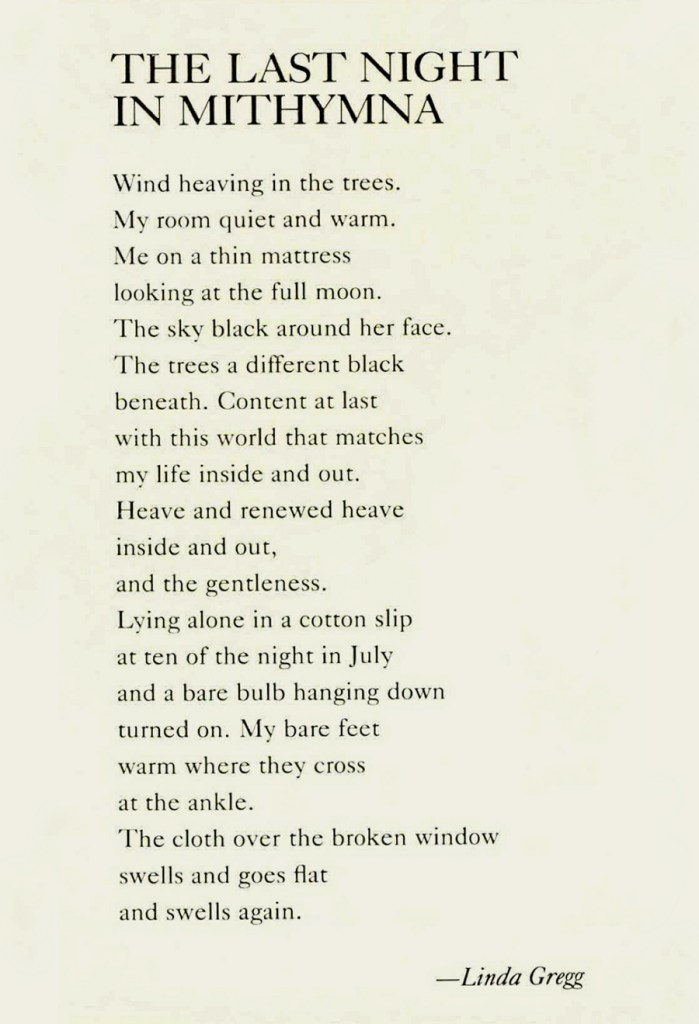
This morning, in a radical departure from my usual doom gathering, I entered “poetry” in the Atlantic search window. An exquisite essay surfaced, with a poem from the Atlantic archives. The author, a poetry professor, makes an unexpected connection between poetry, mindfulness and repair. As people I know have begun their departures from memory, into what we euphemistically call “memory care”, I have gathered up the books we have shared in our long friendships. The inscriptions bring back moments in history when time was our own; we had no idea it was finite. Light slanted across pages read together in trucks and cafes, from morning pillows, and the color of the shadows told us if it was morning or late afternoon. Among the most precious of these books is Sacraments of Desire, by Linda Gregg. It was wonderful to find Gregg’s poem in the Atlantic essay, and to remember how lovely it used to be to read a magazine cover to cover, and to find poetry regularly placed amidst the geopolitical.
I hope you will enjoy this article (a gift link here) every detour in it will take you somewhere worth following.
“Mindfulness is hardly a new idea—when have we not wanted to live more vividly in the present?—but the search for a balanced life has never required so many devices. The word itself has become something of a catchall recently, calling forth an entire industry of platforms, wearable tech, and wellness gurus. Poetry predates all of our meditation apps—and its capacity to immerse the reader in the moment still promises a greater payoff than any smartwatch. A poem tracks our most important data—what we see and hear, what we feel and experience—but not with the intention of creating an optimized version of a human. Rather, poetry addresses one of the root causes of unwellness: a feeling that our own life has somehow gotten away from us.”
—Walter Hunter

 The Iskra Journal
Leave a reply to Anonymous Cancel reply