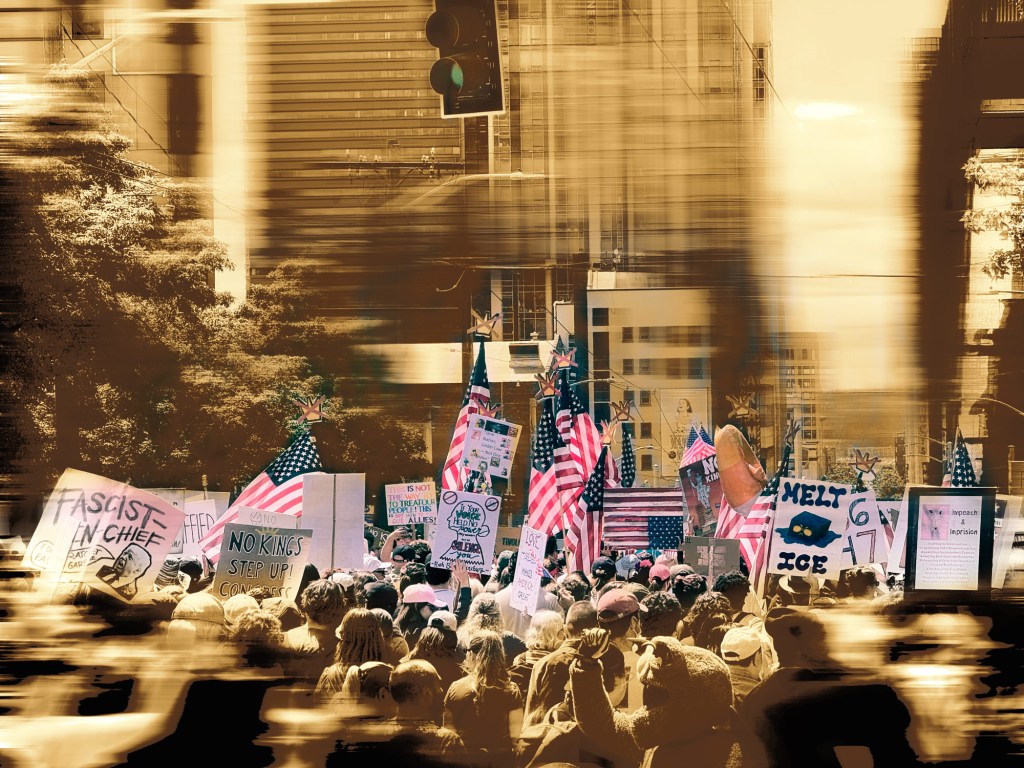
No Kings Day, Seattle Washington
June 14th was a remarkable day. I began the morning in political protest in the company of 70,000 other people, and ended with poetry, taquitos, a carnival, and an unexpected detour into my past. At midnight I drifted to sleep watching coverage of the 7-million-strong No Kings marches across the country, flipping back and forth between peaceful protest and the gray slow-motion cavalcade of tanks commandeered for Donald Trump’s birthday. In Seattle, Cal Anderson Park, which had been a political battle zone in 2020, resurrected in a joyful amphitheater of harmony, purpose and patriotism. Clowns and giant puppets danced through the crowd as speeches celebrating the nation’s history and the struggle for justice echoed from the stage. Thousands of American flags fluttered from hand-held sticks, amid dozens of larger flags on staffs, their finials topped with cardboard crowns crossed out with an “X”.
NO KINGS said it all: the simplest most powerful motto with which to reclaim the symbol of America’s founding. One tenth of Seattle’s population took to the streets, in one of the largest demonstrations in the country.
Meanwhile, the President’s Cabinet pinned small gold busts of Donald Trump to their lapels, in mimicry of the pins worn by the Red Guard in Mao’s Cultural Revolution, and by Kim Jong Un’s courtiers in what is now the 77th year of its dynasty. Fox News reported that Donald Trump proclaimed the No Kings marches were a failure, and commenters assured each other that all 7 million-plus people in the streets had been paid by George Soros. (I am still checking for that donation George!)
Although June 14th offered many Americans a welcome and euphoric glimpse of hope, the day held an undertow. Early in the day reports came in of the assassinations of State Representative Melissa Hortman and her husband, and the attempted assassination of State Sen. John Hoffman and his wife. This comes in the context of two attempts on Donald Trump’s life, and countless threats to judges and political representatives across the country, as rhetoric and rage seep into the collective psyche and become directed to individuals. At this time the assassin appears to have been driven by political ideology although it is not clear from which side.
Dread has an oversized home in my psyche, and events like this send me into urgent late-night dives into every news report, seeking data and patterns. How to weigh the scales? How panicked should I be for the future of my country? Will anyone run for office if the price of Democracy is life? I reflexively checked the news throughout the demonstration, fearing further reports of violence.

After the march I joined a poet from my writing community for the art carnival in Georgetown. My friend writes a poem each day that begins “today love is,” and she will stop writing when the last October 7th hostage is returned by Hamas. As we caught up on the week’s global turmoil and Israel’s strikes on Iran, she told me something I had not known, which is that Iran has a Doomsday clock in Tehran’s “Palestine Square,” predicting Israel’s end by 2040. However strong the justification for the first attacks on Gaza, the motive and goal of Israel’s war on Palestine has grown far beyond retribution, and has metastasized into a grotesque campaign of elimination indistinguishable from genocide. We both agreed: Jews worldwide will pay the price, as Israel’s militarist leaders turn Israel into a pariah state and antisemitism spreads and escalates.
On our return from the Carnival we made a detour through Madrona, past the house where I grew up. My friend marveled at the gardens, the lush forest spilling down to the lake, the meticulous Tudor and Craftsman homes. I described the streets of my childhood, when the neighborhood was a mix of Jewish Americans and holocaust survivors in black fedoras and yarmulkas, intermixed with Catholics who sent their plaid-dressed children to St. Therese a few blocks away. As we drove past what is now just another lovely lake view home, a memory surfaced – but I could not bear to tell her what happened the night of December 24th, 1985, five doors down from my old bedroom.
That evening, as my family gathered around the Christmas tree, we heard the sound of multiple sirens – a sound so unexpected and chilling and close that we stopped mid-motion, unsure of what to do with the gifts in our hands. After a few moments, as the air fell silent, we went to the door and saw police cars gathered, blocking off the corner of 36th and Cherry. We learned the next day that on Christmas Eve the Goldmarks, a family of four, had been brutally murdered by a man named David Lewis Rice. The murders were provoked by what should sound familiar today: an unfounded conspiracy theory that the Goldmarks were Jews involved in a Communist plot to take over America. They were neither Jewish nor Communist. Rice developed his tribal hatred and ideology under the influence of a right wing, antisemitic, anti-communist study group led by retired U.S. Army Colonel Gordon Mohr, a leader of the Christian Patriots Defense League.
It may be the buried memory of this event that gives forboding such a foothold in my moods, which are so often shaped by the news. It is easy to think, in a country distracted by consumer abundance and endless entertainment, with enough money to build a military barricade of safety around our borders, that history has stopped its cycles, cured by better ideas, by science, by secular humanism, or by learning the lessons of history. But in fact I think we just looked away from human nature, fooled ourselves, and forgot.
If I have a poem I write every day, it is the poem of reconciliation between dark and light. I rarely get beyond the second line, and never close the distance between the light in the garden and the sounds of guns. Today’s eloquent post from photographer Chris Jordan describes this impasse well, and I will sign off with his words.
“How does one be with the horrors that are taking place in our world, the atrocities being committed by psychopaths who have lied and bullied their way into positions of power, the untold suffering they are causing to millions of innocent beings for no reason, and at the same time try to go about our lives, be happy, enjoy things, live normally? The feelings of internal dissonance, grief and impotent rage are profoundly disorienting.
I find for myself that looking to beauty for balance never leads to a satisfying place. Beauty doesn’t balance out any of the darkness. All the beauty in the world doesn’t balance out a single act of violence against an innocent being. For me the role of beauty is not to excuse evil, or to divert or medicate the mind. The relationship between these things is not one of balance; they live on different channels, in different dimensions that don’t affect each other. I see horror and beauty more like a kind of zooming-out of the mind. Horror is the narrow view; beauty is the wide-angle panorama. Horror is finite and local; beauty is infinite and everywhere. Human darkness is not the whole story; it is one piece of a bigger picture of the incomprehensible miracle of life and our world and our Universe. . .”
– Chris Jordan


 The Iskra Journal
Leave a reply to Anonymous Cancel reply