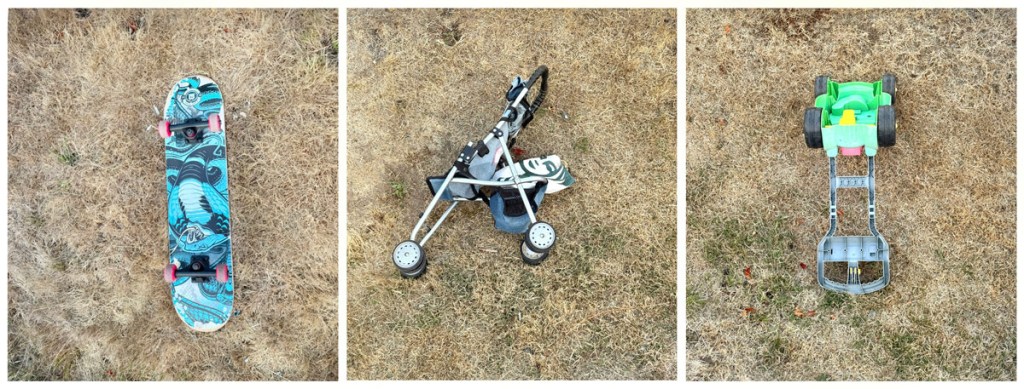
August, more than anything, is defined by the color of grass. City lawns have turned ochre, weedy, crewcut, no longer “lawn” so much as a prickly protectorate embedded with the swords of dandelions, across which no one dare walk barefoot. It is a landscape of exhaustion, where play is reduced to dereliction and the toys lie down with the drought-stricken shrubs in surrender.
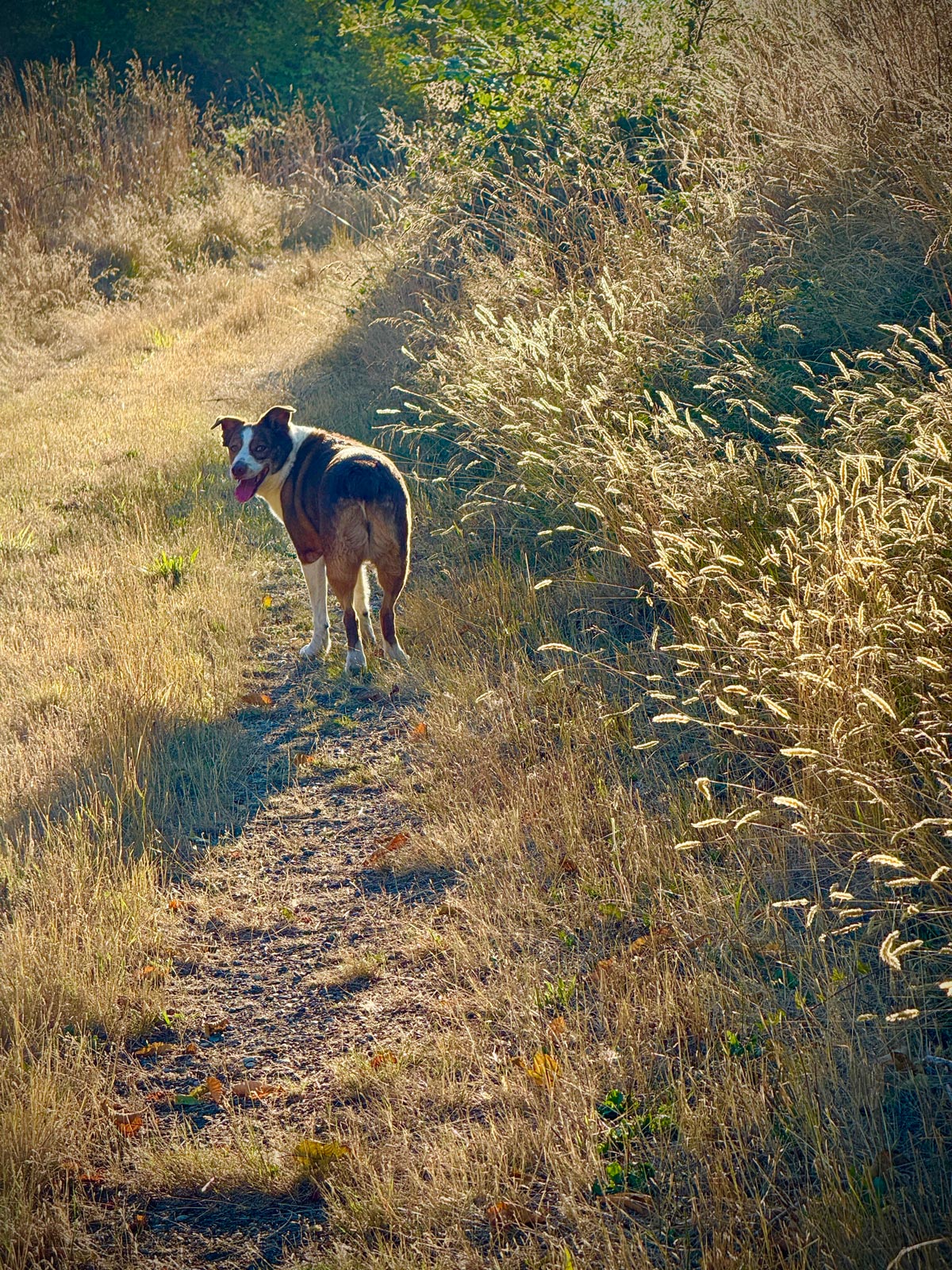
On Whidbey Island the yellow grass lies down in intricate whorls the size of deer. If you are walking an Australian Shepherd every breeze whispers something worth chasing, even if it is invisible, though on rare occasions it takes shape as fleeting hooves and antlers’ candelabra. It is good to have days when there is no excitement but this, the only other task being to observe the mountains, which I did each night and morning during five days in late August. Here, on retreat at the studio compound of artist friends, I rose before 6 to catch the sunrise, and sat each evening in the Adirondack chairs positioned solely for the purpose of watching the sky pulse and fade.

During one of these moments my friend talked about how impossible it was to “design” or otherwise add to the landscape. She had tried to place a sculpture on the site, but it felt like an intrusion. It became clear this was not a place that needed garden improvement: the only thing that belonged here was a tractor, a dog, a deer. Perhaps, in time, an ancient boulder chipped from the mountains.
The first night we sat and talked for hours into the dark. Our lives had braided and separated for over 30 years as we moved through careers in typography, illustration, design and finally our own work, coming to rest here, parallel, on a mountaintop in late August. We talked about painting, how ideas leave and come back, and how to invite them when they seem to have created their own extinction. How to survive the moods. What is the right question to ask when inspiration goes missing?
I remembered telling a Jungian therapist a dream. “There was a table,” I said, “and a bowl and a tin pitcher. It was a painting but real.” She interrupted to ask what seemed like a trivial detail: “What shape was the table?” The analyst moonlighted as a playwright, and I often wondered if my confessions might later appear on stage. Perhaps with this question she was simply working out the lighting and arranging the props, and I flinched as I closed my eyes and tried to remember. I do not recall the Jungian symbolism of the table, or what various shapes might portend, but the question, unlike anything else from our sessions, has hung in the air ever since, waiting to be called on when logic fails.
Shape. It can seem like a layer of abstraction to look at life this way—a chilly intellectual distance. (Although perhaps not distant to the dog, recognizing a rabbit among mingled shades of brown and gold.) Yet in the making of images, shape, before composition or line, speaks most directly to the subconscious. It took me decades to understand this, and to truly see shape. I made my living for nearly 40 years with the alphabet, first as a calligrapher and then as a designer. Typography is symbol, not image, an architecture of abstraction designed to force us to translate symbol into meaning. If we want to see, we have to create image through imagination.
26 letters, black and white, and a handful of awkward numbers and punctuation. When I taught, students asked me how to make it new? I told them to think of calligraphy as dance. Three elements: music, floor, partner. And an invisible fourth: time. With calligraphy the elements are surface, brush, ink. You must learn to hear and feel time, the music of movement: fast, slow, stuttering, sure.
What is visible. What is invisible. You cannot change your life if you do not know its shape.
All this year I have been looking for the shape of things, and trying to understand what I cannot see. From early childhood my path was always one of pilgrimage, defined by disciplines of transformation. By age 20 I had followed and abandoned half a dozen Eastern mystics and their acolytes; for years I considered myself a committed Buddhist. Many of my belief systems did not make it through the shocks of love and loss and were cast aside as delusion. Rigidity gave way to doubt, and the realization after decades of trying that to change the fundamental patterns of life is not an act of conscious effort, built on systems or analysis or resolutions—but one built on unseen alchemy.
I was born in autumn, and all summer I feel that season of reflection and reckoning waiting at the door. My new year begins not in January, but in September. By late August twelve months have passed. If time is an accordian it is wide open by then, expanded, each day of the year tucked within the bellows.
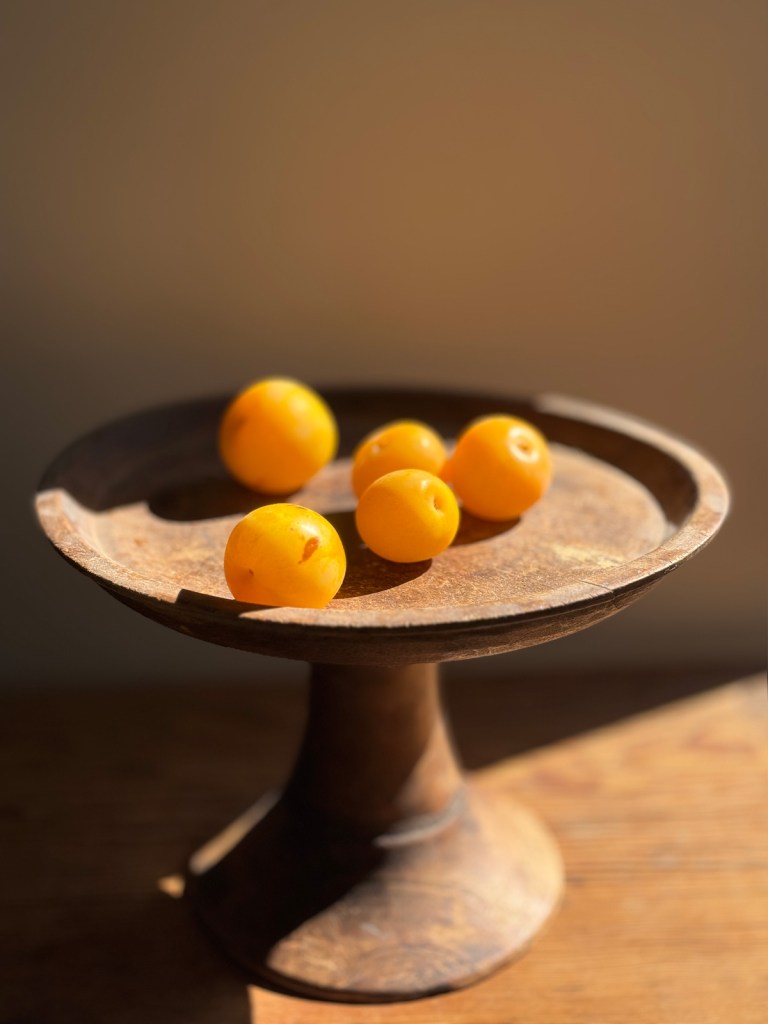
On one of our afternoon walks we came upon a plum tree not yet stripped by deer. In the slanting light we gathered them, each one perfect, glowing orange like fire opals or tourmaline. I arranged them on a wooden pedestal and thought of Caravaggio’s opulent tumbles of fruit glazed in amber, and of the stillness of Muqui’s Six Persimmons, painted without color in shades of gray. In just the time since picking the fruit had changed, beginning its turn towards softness.
I had brought many projects with me to the island, and I did not touch one. I did not know, during these long lazy days, that I was working a riddle in my mind. What is the shape of the life I want? Modern media has consumed me and changed my relationship to the days, and to time itself. The days have no proper sunrise and sunset, they scroll, they drop into an abyss, they swipe, they delete, they overfill external and internal storage and I cannot remember the names of the people right in front of me unless I see their photograph on my phone. The phone says capture me, all of it now and ˆlisten to this and in that terrible rectangle of the camera’s lens is all the distraction and horror of the world, every second of it, saying, it’s all too much, but watch me now.
The plums say otherwise. They say, unpeel me slowly, taste each bite, and write a poem. I want a life that is round like that, that has seasons made of earth and fruit and wind and rivers and sky, that sits on sun-warmed teak, shaped by light. If I have a choice I’d like more light than shadow.
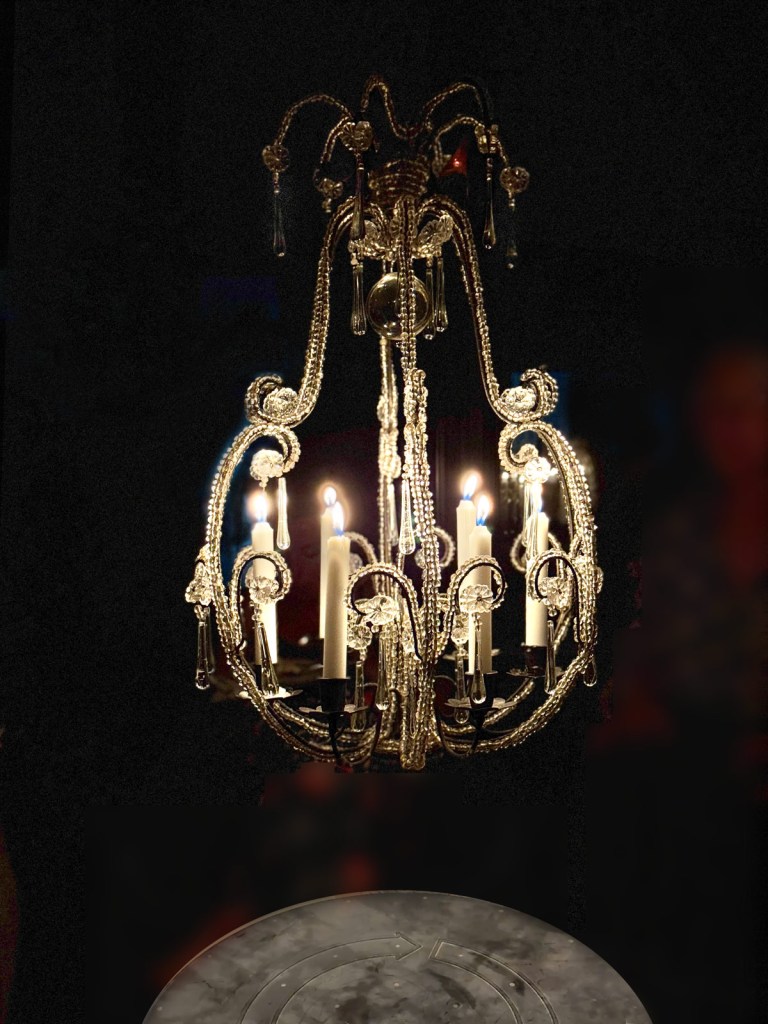
On the last night of my visit 12 women came over for a dinner party. We shared conversation and food, and then moved to an unfinished wing of the house to gather in a circle under a chandelier. In the darkness, candles flickering blue and gold, it glowed like a ritual object, waiting for us to invent the ceremony in which it belonged.
In the past I have squirmed at the reach for ritual where religion and tribe are missing. Outlander, which I watched obsessively in the first year of pandemic, changed my perspective. During that time, cut off from human contact and teetering on despair, the opening dance of druids lit by torches in a stone circle, stones through which you could fall into another time, was often the best sixty seconds of my day. I memorized the soundtrack and wished for a way to vanish, though preferably into a land less brutish than Scotland in 1743.
In this August island circle a simple ritual emerged: simply to speak, one by one, to what the turning of the season meant in our lives. A woman offered her necklace with a large precious stone, and we held it one by one as we spoke. I do not remember all the stories, but I remember feeling part of something rare. Trust, and candles in the dark, and the company of women, my beloved druids, right here. I am not sure what I said when the stone reached me, but I think it was about awakening to the four directions, to elements and the senses, to the affinities of friendship, and the movement, when perplexed, towards a new kind of question. Where are circles overlapping? Is this moment water or stone? what happens when salt sits next to fire? what shape is the table?
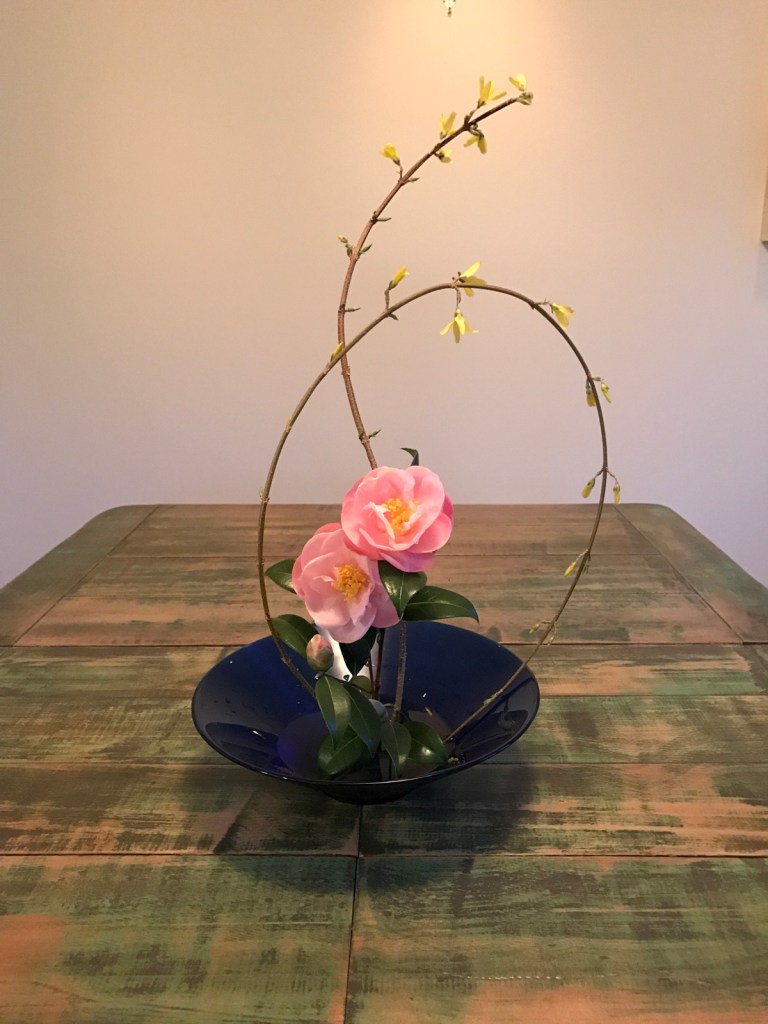
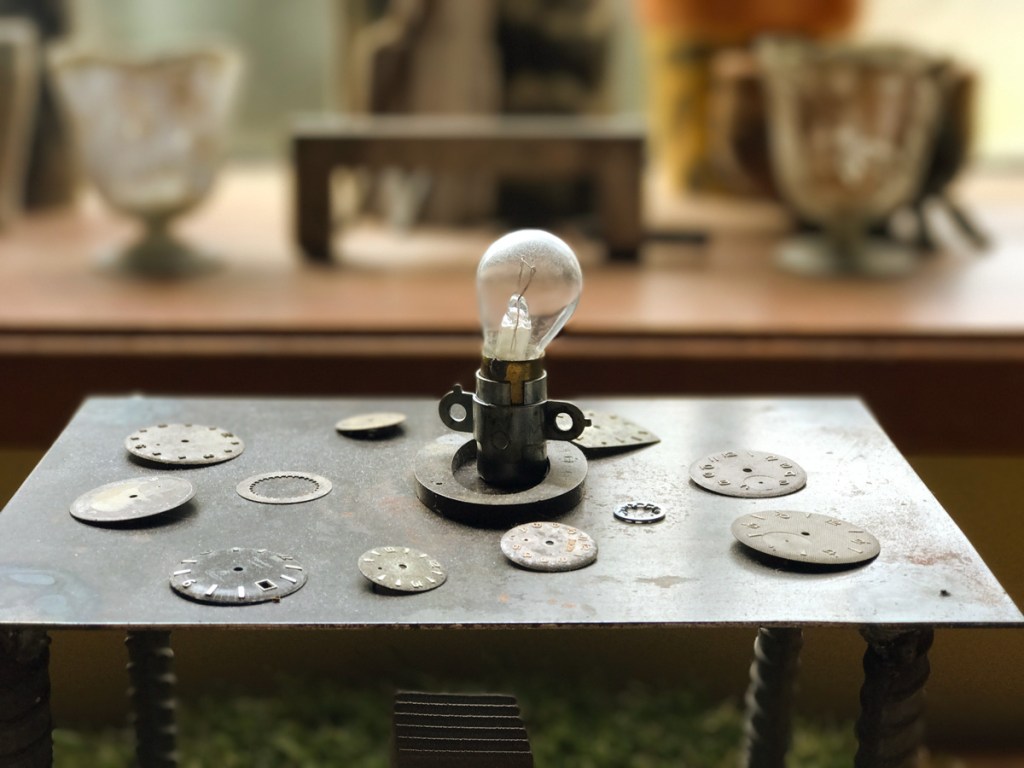
In loving memory of Richard Kehl, who taught us the alchemy of arrangement, the art of juxtapostion, how to squint and how to see.
Words and pictures © Iskra Johnson 2025
 The Iskra Journal
Leave a comment