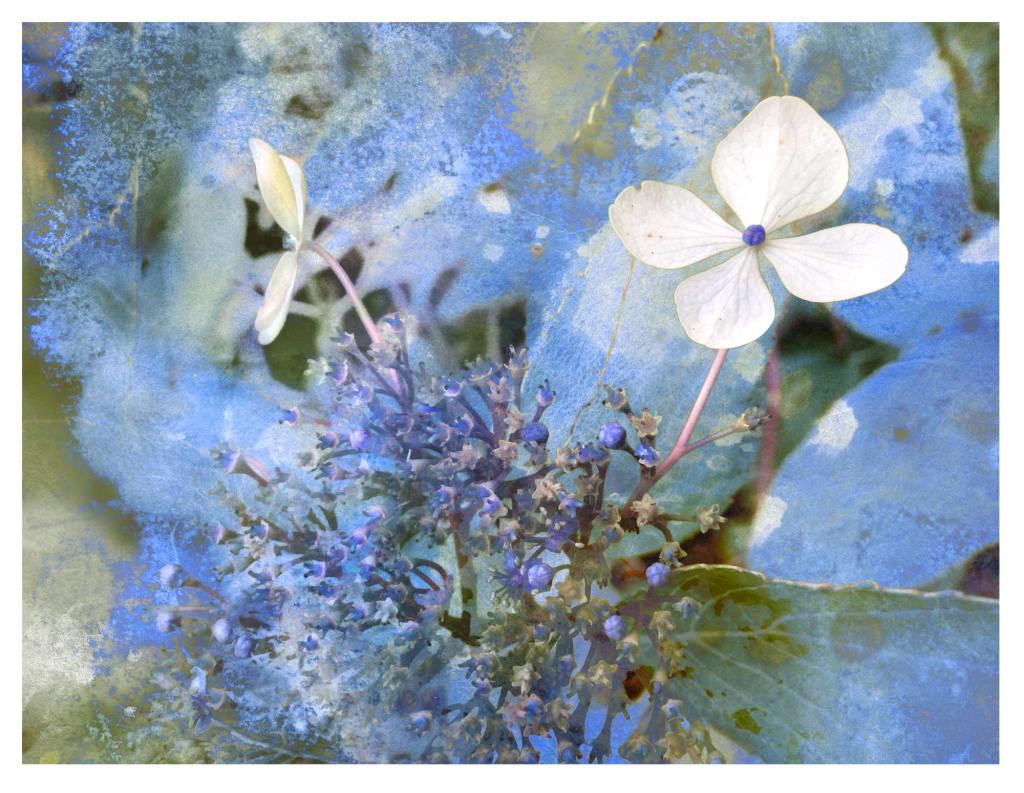
Lacecap in Lapis © Iskra Fine Art
Yesterday was The Fourth of July. Fireworks had started the night before, keeping me up until 2. I woke groggy and leaden, and sat on the deck under a sunless sky, fitfully checking and not-checking my phone for news. In summer drought the lawn, now mostly moss, had begun to tarnish to a murky beige, and the only bright color came from a lace-cap hydrangea, its petals offering me the miraculous blue-violet my nervous system craves.
In May I began scouting the nurseries for everything blue or violet, looking to gather a certain shade seen most sublimely, if only briefly, in the hyacinth. It is true what the mystics and the musicians say about colors. They have the power to heal and to walk us instinctually into rooms of memory and repair. Blue is the color of the Vishuddha Chakra, the throat chakra. I have felt powerless to do anything about The World, powerless to say anything of consequence, and powerless not to watch – choked, you could say – and my nervous system has been run ragged. In the morning I step outside to water the flowers by the door and let the color of African daisies and bell flowers and cranesbill and a particular violet petunia sink into my senses until all thought stops.
In nature there is rarely a “pure” color. Red blends into purple, yellow fades to ochre, every ultramarine shades into violet and then a stem of green. Flags do not behave like this. Flags stake a claim to solids, and on the holiday it is jarring to look up from the garden and see red white and blue flickering through the bamboo above my neighbor’s fence. “These colors don’t run,” the t-shirt says; they take a stand, resolute and untarnished by the solvent of debate or doubt that might make a rainbow.
As political realities unfold and the country is dismantled from within, it becomes harder and harder to hold onto simple pleasure. The only way to do it is not to know what is going on. To look at the cosmetic ads and the funny wedding dancers and the AI videos of cats lifting weights and washing dishes and shield your eyes from everything else. If you look, you see the streams of masked men in black balaclavas and paramilitary fatigues smashing windows and blowing up front doors and hauling grandmothers and children out of their homes, pulling workers out of the fields, and notching numbers on the belt of the all-white nation the leaders of the government have decided is the future.
If you look, the whole big wonderful picnic – the potato salad, the mingled scents of barbecue and sun tan oil, the sulfur fumes of fire works, the children running with sparklers, the lawnmower parades and Uncle Sam in stripes on stilts – all seem drained of innocence and more like the obese illusions of a nation living on cotton candy. I have never minded the kitsch. Even at my most politically alienated, I have loved Uncle Sam. I love stars and stripes and watermelon, and a crowd under the night sky unified in gasps of awe. I have always been able, on this one day, to divorce ritual from dissonance and enjoy the sheer exuberance of primary colors. Today feels different. I want only to look at blue, undivided, unmartialed, without regiment or rank, designated sensory survivor in the search for peace.
During pandemic I took a regular 7-mile walk once a week. The walk starts at a stairway above Golden Gardens, goes south through Sunset Hill to the Locks, passes over a railway and then turns along the sound past the marina, finally ending at the beach, before turning upward to 4 daunting sets of stairs. I only occasionally passed a person, always masked, who often moved to the other side of the street as soon as they saw me. I stopped looking a people and concentrated on gardens, getting to know each tree and shrub and the cycles of their seasons. Now on this path there are people on the streets, and faces, and dogs, and I think how there has been only a year or so of relaxing into this, finally fulling testing the sense of “normal” only to be plunged back into what feels like a deep illness, a contagious virus of disruption to the civic order.

Generations, © July 2021 Iskra Fine Art
Signs of the 4th are few, although one house sports a massive official-looking pole with four small flags on smaller poles arranged around it like flowers tucked in a vase. In the steely light, color seems oddly bleached, the white houses paler, the usually blazing gardens limp. I find a patch of blue cranesbill geraniums in a parking strip, and then a patch of pure cobalt on a small wooden boat, and stop at the water to watch it shift shape in the long pale alleys of reflected yachts. I follow the mile of marina until it curves and docks give way to the vast shore of Golden Gardens. I came here in July of 2021, when for a week or two the virus seemed under control, and public gatherings resumed. I remember watching the people at the beach and being dizzy with the beauty of the human body, and shocked into an intense tenderness: the vulnerability of unclothed skin, a child wading barefoot for the first time into water, the gentle tilt of bodies towards each other, and faces upturned in wonder to the sun.
Today the sun remains obstinately absent, and water, sky and sand are all the same metallic gray. The air is thick with charcoal smoke and grease and the sound of boomboxes, the chattering of crowds gathered at picnic tables, and I feel suddenly overwhelmed by my own anonymity. I sit on a bench at the edge of the sand and raise my camera to photograph, looking at the space between bodies, the shapes of water between umbrellas and legs and arms, and unexpectedly it returns: immersion in the joy of human theater. I capture frame after frame of bodies in silhouette, the bather reaching for a towel, the child pouring sand, the athletes’ leap and pirouette and the arc of the ball – and then blur them, instinctively softening faces to keep them from being identified. The group of people in front of me, young and beautiful in their trunks and bikinis, have accents, and they are a shade of brown that does not come from tanning, and I blur them more, wondering who is a citizen; who, on command, can pull a passport out of their bathing suit, who would go limp and who would be tackled as they are hauled into a van.

Under the Flag © 2025Iskra Johnson
As I rise to finish my walk I scan the parking lot for police and sigh with relief to see just two, parked and idly chatting, as though it were any normal day. The last leg of the journey is straight up and then switchbacks through forest. During pandemic I lost my lung capacity. Whether it was due to an invisible side effect of Covid, lethargy or age, I don’t know, but I dread my slowness and the ache in my knees. I look downward and count steps and push until I am at the last landing before the steepest stair. Midway up, resting, I see a small child in pink and yellow stripes and a woman holding her hand. I tell myself surely I will pass them, but they arrive at the top a full minute before I do, and I congratulate them. The woman says, shakes her head softly and says, “We both have cystic fibrosis.” I look more closely and see the child’s pallor, and wonder what this life is like. I tell the girl I love her striped skirt and her hat, and she smiles. We are nameless, but not anonymous, and this moment, of all the others in this uneasy anniversary of my country’s birth, brings me back to where I want to be. Just human – a citizen of the world.
© 2025 Iskra Johnson
 The Iskra Journal
Leave a comment